


Why puppies need to chew
Puppies explore the world with their mouths. Chewing helps them learn, burns energy and soothes sore gums when adult teeth are coming in. If you don't give a puppy something appropriate to chew, it will find something on its own: shoes, cables, table legs or your hands.
The goal is not to stop chewing. The goal is to direct it to the right things. A safe, approved chew does exactly that and teaches your puppy a simple rule early: this is mine, the couch is not.
The puppy teething timeline
According to the American Kennel Club, puppies follow a predictable teething timeline:
| Age | What happens |
|---|---|
| 2 to 4 weeks | Baby teeth start to come in |
| 5 to 6 weeks | All baby teeth are in, about 28 in total |
| 12 to 16 weeks | Baby teeth fall out as adult teeth push through |
| About 6 months | Adult teeth are in, about 42 in total |
The AKC recommends offering safe chew toys during the 12 to 16 week stage, when teething discomfort is at its peak, and asking your vet to check any baby teeth that are still there after six months.
When can a puppy have a bully stick?
There is no single age that fits every puppy. Breed, size, chewing strength and stomach sensitivity all matter. That is why the best first step is to ask your vet at your next puppy visit. Many owners introduce bully sticks once the puppy is eating solid food well and can be supervised closely during short sessions.
How to give a puppy a bully stick, step by step
- Get your vet's OK for your puppy's age, size and diet.
- Pick the right size. The stick must be longer than your puppy's mouth is wide, so it can't be swallowed whole. The AKC advises choosing chews large enough that the dog can't get the whole thing in its mouth.
- Keep sessions short. Start with 5 to 10 minutes, then put the stick back in a sealed bag.
- Supervise every session. Stay in the room and watch how your puppy chews.
- Take away the last piece. When the stick is short enough to swallow, replace it with a treat and throw it away.
- Wash your hands. The FDA recommends washing for at least 20 seconds after handling pet treats.
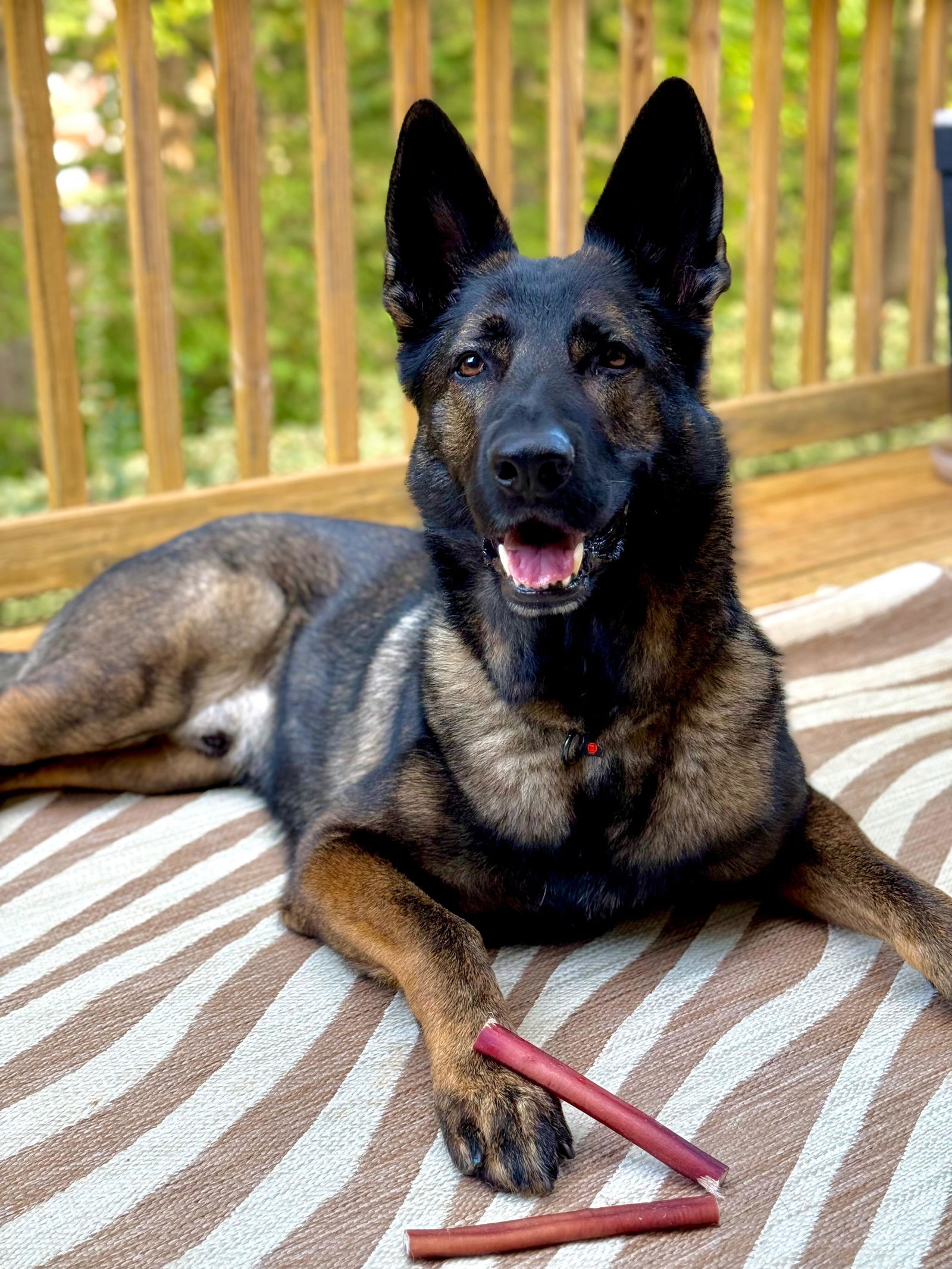
Calories: the part owners forget
A puppy's stomach is small and its daily calorie budget is tight. Bully sticks are almost pure protein: in the sticks Tufts University researchers measured (Canadian Veterinary Journal, 2013), each inch carried 9 to 22 calories, so an average 6-inch stick came to about 88. That is roughly 30% of what a 10-pound dog eats in a day. For a young puppy, a whole stick in one day is too much food.
Use part of a stick per session and adjust meals on chew days. Your vet can tell you your puppy's daily calorie target.
Use chew time to build calm behavior
Chew time is a training opportunity. A chew is calming for most dogs, so use it at the moments you want your puppy to learn to relax:
- Crate time: a short chew session helps the crate feel like a good place.
- After training: end a training session with a chew so your puppy learns that work leads to reward.
- Settle on a mat: give the chew only on the mat to build a calm "place" habit.
Our training method explains how to build calm, reliable behavior from day one.
Teach "drop it" with a bully stick
A bully stick is the perfect tool to teach one of the most important skills a puppy can learn: letting go of something on cue. It also makes it easy to take the stick away when it gets short, without a tug of war.
- Start with a trade. While your puppy chews, hold a tasty treat near its nose.
- Mark the release. The moment your puppy lets go of the stick, say "drop it" in a calm voice and give the treat.
- Give it back. Return the stick right away most of the time. Your puppy learns that letting go is not losing the chew.
- Practice often. Repeat 3 to 5 times per session, then end with the puppy still chewing.
- Use it for real. When the stick gets short, ask for "drop it," trade for a treat and put the stick away for good.
Practicing this way also helps prevent resource guarding, because your puppy learns that a hand near its chew means something good is coming.
Build a simple daily chew routine
Puppies thrive on predictability. A short, consistent chew routine helps your puppy settle and gives you a calm moment in the day:
- Same time: after a walk or a training session, when your puppy is ready to wind down.
- Same place: a mat or the crate, so chewing happens where you want it.
- Same rules: supervised, short, and the stick goes back in the bag at the end.
Bully sticks vs. other puppy chews
Bully sticks are not the only option. Here is how they compare with other common puppy chews:
| Chew | Good for puppies because | Watch out for |
|---|---|---|
| Bully stick | Single ingredient, high-value, the AKC calls it easily digestible | Calories; remove the last piece |
| Rubber chew toy | No calories, can be frozen for sore gums | Pick the right size; replace when damaged |
| Rawhide | Long-lasting | The AKC warns swallowed chunks can cause choking or blockages |
| Antlers and hard bones | Very long-lasting | Very hard on developing teeth |
Many owners rotate between a rubber toy and a bully stick: the toy for everyday chewing, the bully stick as a special reward.
What if my puppy swallows a piece?
If your puppy swallows a small, softened piece, it will usually pass. Watch your puppy closely for the next 24 to 48 hours. Call your vet right away if your puppy swallowed a large piece, or if you see gagging, repeated vomiting, straining to poop, a sore belly, low energy or loss of appetite. If your puppy is choking and can't breathe, go to an emergency vet immediately.
Puppy chew safety checklist
- Vet has approved chews for your puppy's age and diet
- Stick is longer than your puppy's mouth is wide
- Session is short and supervised
- Last small piece is taken away
- Meals are adjusted on chew days
- Sticks are stored in a sealed bag, and you wash your hands after handling
Common mistakes to avoid
- Leaving a puppy alone with a chew
- Giving a stick that is too short or too thin
- Letting the puppy finish the last small piece
- Giving a full stick every day without adjusting meals
- Skipping the vet check for very young or sensitive puppies
A simple chew for every stage
INVIROX bully sticks are 100% grass-fed beef, one ingredient, in packs of 5 to 25. Subscribe & Save for 15% off every delivery, every 2, 4 or 6 weeks. Change, pause or cancel anytime.
Shop bully sticksFrequently asked questions
Can puppies have bully sticks?
Many puppies can, as a short, supervised chew. Ask your vet about your puppy's age, size and diet first.
How long should a puppy chew a bully stick?
Start with 5 to 10 minutes per session and increase slowly as you learn how your puppy chews.
Are bully sticks good for teething puppies?
The AKC recommends safe chews during teething, which peaks at 12 to 16 weeks. Keep bully stick sessions short and supervised.
When do puppies get their adult teeth?
According to the AKC, adult teeth are usually all in by about six months, about 42 teeth in total.
How many calories are in a bully stick?
A Tufts University study measured 9 to 22 calories per inch, about 88 calories in an average 6-inch stick.
What size bully stick is best for a puppy?
Choose a stick your puppy can't fit entirely in its mouth, and take it away once it gets short.


