


What is beef pizzle?
Pizzle is the old butcher's word for the penis of a bull. It is a long, lean muscle with very little fat, and it is a by-product of beef processing, the same way liver, tripe or tendons are. Instead of going to waste, it is turned into one of the most popular natural dog chews in the U.S.
Many owners are surprised when they learn this. A study from the Cummings School of Veterinary Medicine at Tufts University surveyed 852 people and found that only 44% of respondents knew bully sticks come from bull penis, and even among veterinarians only 62% identified the source correctly. So if you just found out, you are in good company.
The name "bully" simply comes from "bull." You will also see bully sticks sold as pizzle sticks, beef pizzle or bull pizzle. They are all the same product.
How bully sticks are made, step by step
Every brand has its own process, but the basic method is the same everywhere:
- Sourcing. The pizzle is collected during beef processing. The quality of the cattle matters: grass-fed beef is leaner and has a cleaner taste.
- Cleaning and trimming. The raw muscle is washed thoroughly and trimmed.
- Stretching and hanging. It is stretched and hung vertically. The length of the finished stick depends on the size of the original pizzle and how far it is stretched.
- Drying or baking. This is the most important step. The pizzle is dried or slowly baked at controlled temperatures for several days. This removes moisture, hardens the stick and makes it shelf-stable. Longer, well-controlled drying produces a harder, longer-lasting chew with less odor.
- Cutting and packing. The dried sticks are cut to standard lengths (6 and 12 inches are the most common) and sealed.
Some bully sticks are also braided, twisted or shaped into rings. The ingredient does not change, only the shape and density.
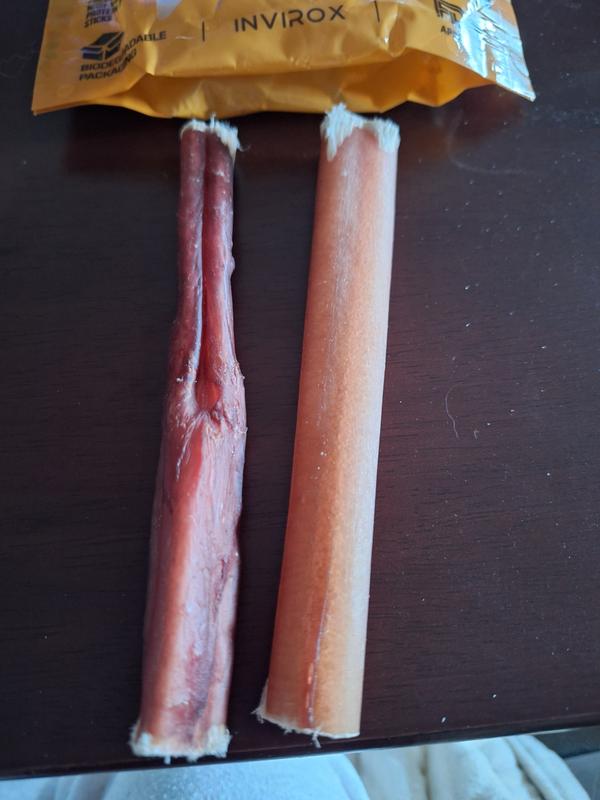
What's inside a bully stick: protein and calories
Because a bully stick is a single muscle, it is mostly protein. That is what makes it a high-value reward for most dogs. But protein also means calories, and this is the part many owners miss.
The Tufts University study, published in the Canadian Veterinary Journal in 2013, looked at 26 bully sticks bought from U.S. and Canadian retailers. In the sticks it tested for calories, it found 9 to 22 calories per inch. An average 6-inch stick had about 88 calories, roughly 9% of the daily calorie needs of a 50-pound dog and about 30% for a 10-pound dog.
| Dog size | Calories in an average 6-inch bully stick | Share of daily calorie needs (Tufts study) |
|---|---|---|
| 10-pound dog | About 88 | About 30% |
| 50-pound dog | About 88 | About 9% |
Bully sticks vs. rawhide and other chews
The biggest reason owners switch to bully sticks is what they are not. Rawhide is made from the inner layer of a cow or horse hide, and it is often processed with chemicals to clean and shape it. A bully stick is a muscle, not a hide, and it is a single ingredient.
The American Kennel Club describes bully sticks as easily digestible, single-ingredient beef chews, while warning that power chewers can break off large chunks of rawhide that can cause choking or get lodged in the intestines. The AKC also notes that very strong chewers can bite through a bully stick and create large pieces, so size and supervision still matter.
| Chew | What it's made of | Ingredients | Main watch-out |
|---|---|---|---|
| Bully stick | Beef pizzle (muscle) | One | Calories; remove the last small piece |
| Rawhide | Inner layer of cow or horse hide | Hide plus processing | Large swallowed chunks |
| Antlers and bones | Bone or antler | One | Very hard, can damage teeth |
| Dental chews | Mixed formula | Many | Ingredient list varies by brand |
Grass-fed vs. grain-fed: does the beef source matter?
All bully sticks come from cattle, but not all cattle are raised the same way. Grass-fed cattle spend their lives grazing on pasture, while grain-fed cattle are usually finished on corn and soy in feedlots. Grass-fed beef is generally leaner, and many owners prefer it because it is closer to a natural diet.
For a single-ingredient chew, the quality of that one ingredient is everything. When you compare brands, look for a clear statement of where the beef comes from and how the cattle were raised. If a listing doesn't tell you, that is worth noticing. INVIROX bully sticks are made from grass-fed Brazilian beef, and it says so on every bag.
Bully stick shapes, lengths and thickness
Bully sticks come in several formats. The ingredient is the same, but density and chewing time change a lot:
| Format | What it is | Best for |
|---|---|---|
| Standard 6-inch stick | A straight, dried pizzle cut to 6 inches | Most medium and large dogs |
| 12-inch stick | The same stick, cut longer | Large dogs, or cutting into two sessions |
| Thick or jumbo stick | A wider pizzle from a larger animal | Strong chewers who finish thin sticks fast |
| Braided stick | Several thin strips twisted together | Dogs who enjoy a tougher, longer chew |
| Bully ring or shape | A stick bent and dried into a ring | Variety; supervise the same way |
Whatever the format, the safety rule doesn't change: pick a stick your dog can't fit fully in its mouth, and take it away when it gets short.
How long does a bully stick last?
It depends almost entirely on your dog. A gentle chewer can work on one stick across several sessions over a few days. A strong chewer with a big jaw may finish a standard stick in one sitting. Thicker sticks and braided sticks usually last longer. If your dog finishes sticks very quickly, go thicker, use a holder and keep sessions short.
Why some bully sticks smell (and others don't)
Bully sticks have a natural beef smell. How strong it is depends mostly on how the stick was cleaned and how long and how well it was dried. Under-dried sticks keep more moisture and smell stronger, especially when a dog wets them while chewing.
A few simple habits keep odor down at home: store sticks in a sealed bag, give the chew in one area (a mat or crate), and put a half-chewed stick back in the bag between sessions.
How to store bully sticks
Bully sticks are dried, so they keep well, but storage still matters for freshness and hygiene. The U.S. FDA recommends keeping pet treats in a cool, dry place below 80°F, in the original packaging with the top tightly sealed, and washing your hands for at least 20 seconds before and after handling pet food and treats.
- Keep the bag sealed between uses.
- Store a half-chewed stick back in the bag, not on the floor.
- Throw away any stick that becomes soft, slimy or moldy.
How to read a bully stick label
Use this quick checklist before you buy:
- Ingredient list: it should say beef pizzle or 100% beef, nothing else.
- Beef source: grass-fed is leaner. The label or listing should say where the beef comes from.
- Length and thickness: choose a stick longer than your dog's mouth is wide.
- Packaging: a resealable bag keeps sticks dry and fresh.
- Price per stick: multi-packs are usually far cheaper per stick than single sticks.
What's in INVIROX bully sticks
INVIROX bully sticks follow the simplest possible recipe: one ingredient, 100% grass-fed beef from Brazil, with nothing added. They are a long-lasting chew made for medium and large dogs, and they work well as a high-value reward after training sessions.
- Guaranteed analysis: crude protein 83% minimum, crude fat 5% minimum, crude fiber 1% maximum, moisture 12% maximum
- Packs of 5, 10, 15, 20 and 25 sticks
- The bigger the pack, the lower the price per stick
- Subscribe & Save: 15% off every delivery, every 2, 4 or 6 weeks
- Change the interval, pause or cancel your subscription anytime
One ingredient. 100% grass-fed beef.
Subscribe & Save and get 15% off every delivery. Pick every 2, 4 or 6 weeks, and change, pause or cancel anytime.
Shop bully sticksFrequently asked questions
What are bully sticks made of?
Bully sticks are made from one ingredient: beef pizzle, the penis muscle of a bull or steer. It is cleaned, stretched and dried or baked into a hard chew.
Are bully sticks made from bulls?
Yes. The name comes from "bull." They are made from beef pizzle collected as a by-product of beef processing.
Do bully sticks contain additives or preservatives?
A true bully stick is a single ingredient. INVIROX bully sticks are 100% grass-fed Brazilian beef with nothing added.
How many calories are in a bully stick?
A Tufts University study found 9 to 22 calories per inch. An average 6-inch stick had about 88 calories.
Are bully sticks better than rawhide?
Many owners prefer them because a bully stick is a single natural muscle, while rawhide is processed hide. The AKC describes bully sticks as easily digestible.
Why do bully sticks smell?
They have a natural beef smell. Sticks that are dried longer and stored in a sealed bag smell much less.


